
DecisioningIT Blog, August 2026
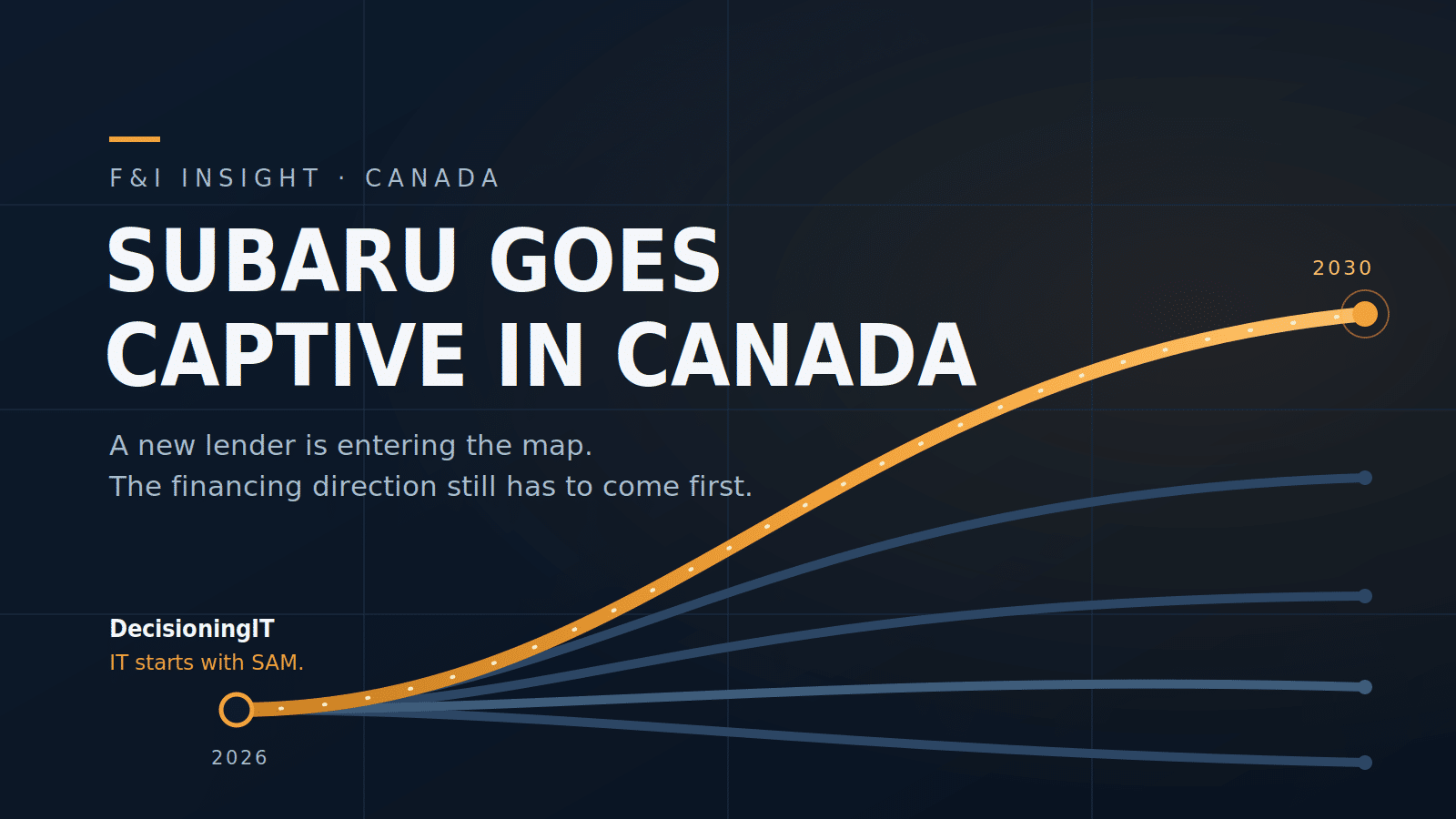
On August 5, 2026, Subaru Corporation and Subaru Canada announced the creation of a captive finance subsidiary in Canada. The new entity will offer retail loans, leases and dealer inventory financing directly to Subaru customers and to the Subaru dealer network, with a full launch planned by 2030.
During the transition, Subaru Canada will continue working with its long-time partner, Toyota Credit Canada Inc. (TCCI), through Subaru Financial Services by TCCI. Customers with an existing loan or lease are not affected. According to Yoichi Hori, Chairman, President and CEO of Subaru Canada, the move is designed to support the sales division and the dealer network more closely, strengthen direct relationships with Canadian customers and create long-term value for shareholders and partners.
The Canadian announcement is not an isolated decision. Subaru of America confirmed the same strategy south of the border: a captive finance arm operational by 2030, with its current white-label partner Chase (operating as Subaru Motors Finance) extended until the transition is complete. Subaru is aligning its entire North American financing strategy around direct control of the credit relationship.
Why manufacturers want their own captive
Captive lenders are not a side business for OEMs. In the United States, Experian’s State of the Automotive Finance Market report shows captives held over 53% of new-vehicle financing in the first quarter of 2026. A captive gives the manufacturer three levers that a third-party lender cannot fully replicate:
- Incentive control. Subvented rates and lease programs become internal decisions, not negotiations with a banking partner.
- Customer data and retention. The financing relationship is the longest touchpoint in the ownership cycle. Owning it means owning the renewal conversation, the equity position and the trade cycle timing.
- Dealer support. Floorplan and inventory financing tie the dealer network more closely to the brand, especially in periods of rate volatility.
Subaru was one of the last major manufacturers in Canada without its own captive. This announcement closes that gap and confirms a broader trend: the financing relationship has become as strategic as the vehicle itself.
What this changes for Canadian dealers
For Subaru dealers, the transition period matters as much as the destination. Between now and 2030, they will operate with TCCI as the incumbent, a new captive being built in parallel, and the usual roster of banks and non-prime lenders. That is more complexity, not less.
And complexity is exactly where the Canadian market is heading. The J.D. Power 2026 Canada Dealer Financing Satisfaction Study, released in May, describes an environment where affordability pressure, negative equity and customer fragility are forcing dealers to expect more from their lenders. The study found that dealers reward lenders who act as collaborative partners rather than transactional executors: 64% of dealers working with the top-ranked captive say they will definitely increase business with that lender over the next 12 months. Speed is now a baseline expectation, with roughly two-thirds of dealers expecting funding and credit staff to respond within 30 minutes.
Read together, the two announcements say the same thing: lenders are competing on collaboration and speed, and manufacturers want direct control of the credit relationship. The dealer sits in the middle of that competition. The dealers who benefit will be those who arrive at the lender conversation already knowing where the deal should go.
The dealer’s answer: financing intelligence before the lender conversation
A new captive changes the lender map. It does not change the fundamental question every deal starts with: which financing direction fits this customer, and what is the full potential of this deal?
That question cannot wait for the F&I office. When a dealership knows the financing direction from the very first customer contact, whoever initiates the request, the conversation with any lender, captive or not, starts from a position of clarity. The desk works the right structure, the F&I office prepares the right presentation, and the lender receives a file that matches its programs.
This is exactly the role SAM plays in the dealership ecosystem. From a single credit pre-qualification request, SAM produces a financing direction and a profitability benchmark for the deal. It does not approve, it does not decide: the final authority always remains with the F&I manager and the lenders. What it does is give the dealership visibility on the full potential of each deal before the file ever reaches a lender’s desk. As the lender landscape gets more crowded, that discipline becomes the difference between reacting to lender programs and steering toward them.
Subaru’s captive will not be fully operational before 2030. The complexity it announces is already here.
IT starts with SAM.
Sources: Subaru Canada / CNW press release, August 5, 2026; Automotive News, August 2026; J.D. Power 2026 Canada Dealer Financing Satisfaction Study, May 2026; Experian State of the Automotive Finance Market, Q1 2026 (US data).