
In just a couple of decades, China has gone from almost invisible in global auto sales to one of the most powerful forces in the industry.
From Zero to 40%: China’s Rapid Ascent
If you rewind 25 years, Chinese automakers held virtually no share of global new-car sales.
Fast forward to today, and Chinese OEMs now account for around 40% of all new vehicles produced worldwide.
That’s not just a story of growth—it’s a complete restructuring of the global competitive landscape.
The Overcapacity Engine: 45 Million Cars, 25 Million Buyers
China’s domestic new-car market is huge—about 25 million units per year.
But here’s the kicker: the country now has production capacity for roughly 45 million vehicles annually.
That leaves a massive 20 million-unit surplus that needs to find a home outside China. And Chinese OEMs are aggressively exporting that overcapacity to markets where tariffs and regulations allow them to compete freely.
Where they can go, they’re not just entering quietly—they’re taking big bites of market share.
Where Chinese Automakers Are Winning
Chinese brands are already reshaping competitive dynamics in several key regions:
- Australia: Chinese market share of new-car sales has gone from 0% to about 40% in just five years. That’s a historic shift in an incredibly short window.
- Mexico: Chinese automakers now sell around 10% of all new vehicles, and they’re still growing.
In these and other markets without prohibitive tariffs, the Chinese formula—strong value, solid quality, and compelling tech—is proving very hard to beat.
Why the U.S. Is (Temporarily) Insulated
For now, the U.S. market is effectively protected by steep tariffs.
With 100% tariffs in place, Chinese automakers can’t compete on price in the U.S., which has slowed their entry.
But that doesn’t mean U.S., Japanese, and European automakers are safe. While traditional brands like GM, Ford, Stellantis, Toyota, and Honda are protected at home, they’re losing share in international markets where Chinese brands are free to compete and are building new plants.
In other words: the battle is already well underway—just not yet on American soil.
From “Cheap” to “World-Class”: The Quality Revolution
Two decades ago, Chinese cars were often dismissed as low-quality and unrefined. That perception is now badly out of date.
Today, Chinese automakers are:
- Building vehicles that are on par with, or better than, many legacy OEMs.
- Delivering more features, more technology, and better perceived value at a lower price point.
How did they get there so quickly?
Much like Toyota in the 1960s, Chinese OEMs had the advantage of starting later and reinventing the manufacturing process from scratch. Through joint ventures with brands like Toyota, Honda, and GM, they learned how the global leaders build cars—then redesigned their own plants, processes, and supply chains from the bottom up.
The result:
High-quality production + radically efficient cost structures.
And this transformation has happened in an incredibly short period of time.
BYD: China’s Poster Child for Disruption
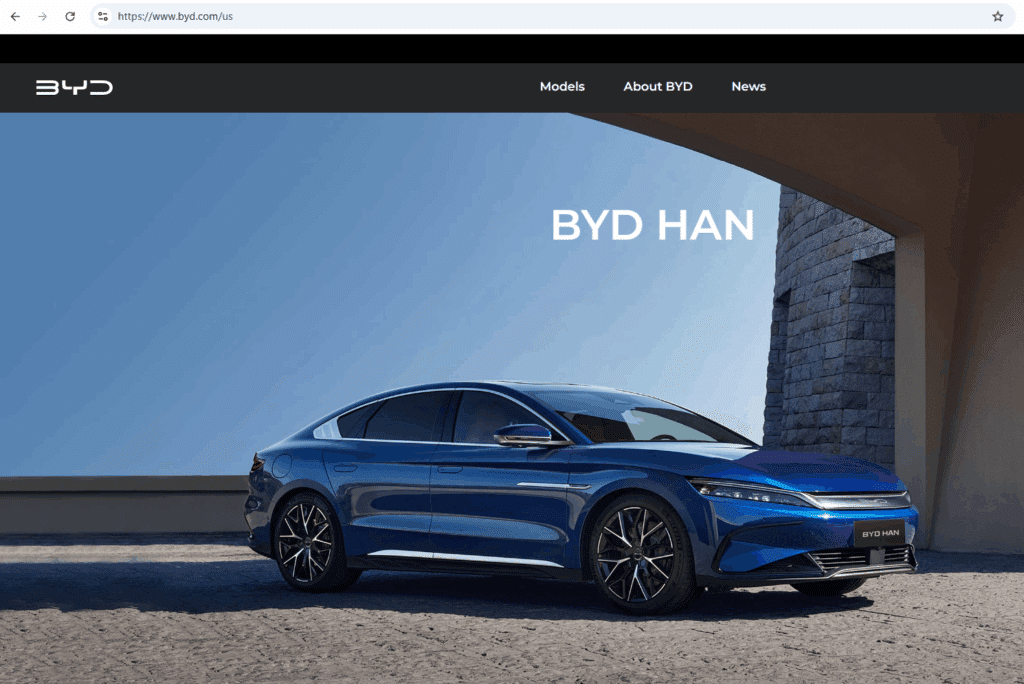
If there’s one company that symbolizes this shift, it’s BYD.
- Back in 2008, when Warren Buffett invested, BYD was best known as a contract manufacturer of cell phone batteries.
- BYD didn’t produce its first car until 2005—that’s only about 20 years ago.
Today, BYD is forecasted to sell around 4.5 million vehicles in 2025.
At its current growth trajectory, it may only be a few years away from surpassing Toyota as the largest automaker in the world.
Think about that: a company that wasn’t even in the car business two decades ago is now within striking distance of an industry titan that’s been around since the 1930s.
What This Means for Legacy Automakers
So where does this leave the established players—Ford, GM, Toyota, Honda, Stellantis, and others?
In business, people often say that competition makes everyone stronger, and that a clearly defined rival can sharpen focus and intensify effort.
Chinese automakers have shown the world that it’s possible to:
- Innovate faster
- Build high-quality vehicles
- Do it all at a lower cost, with lean, modern manufacturing systems and highly integrated supply chains
Legacy automakers are now being forced to wrestle with some urgent questions:
- How do we rethink our cost structure to compete with Chinese efficiency?
- How do we accelerate product development cycles without compromising quality?
- How do we differentiate our brands in markets where Chinese vehicles undercut us on price and match us on tech and quality?
- How do we defend global market share while also funding the massive transition to electrification and software-defined vehicles?
There’s no easy answer—but ignoring the threat is not an option.
Rise to the Challenge
The rise of China’s automakers isn’t a hypothetical future scenario—it’s already here. The only real unknown is how quickly this disruption will fully hit every region of the world.
For legacy automakers, the takeaway is clear:
- The benchmark has moved.
- The competition is faster, leaner, and more aggressive.
- The time to respond isn’t “someday”—it’s right now.
Those that embrace this moment as a catalyst—to simplify, modernize, and move faster—can absolutely remain relevant and profitable in the new era.
Those that don’t may find themselves looking back on this period as the moment the industry changed… and they didn’t.